Choosing reliable equipment partners is essential for paper producers seeking stable quality, efficient production, and controlled operating costs. This guide examines the Top 10 Paper Coating Machine Manufacturers Worldwide through practical and technical criteria. It considers coating methods, machine width, production speed, drying performance, automation, energy consumption, and after-sales support. These factors influence real factory results more than impressive brochures.
A capable Paper Coating Machine should deliver an even coating layer across the entire web. It should also reduce streaks, pinholes, web breaks, and unnecessary material waste. Our review considers solutions for publishing paper, packaging board, specialty grades, and coated industrial papers. Particular attention is given to blade, rod, roll, spray, and curtain coating technologies. Service experience matters too. Installation guidance, operator training, spare-parts access, and responsive troubleshooting can protect production schedules.
Details matter.
A machine running at 1,800 meters per minute may appear attractive, but speed alone proves little. Drying capacity, coating chemistry, paper moisture, and reel stability must work together. Manufacturer credibility is assessed through engineering capability, documented applications, customer references, and long-term support. However, no ranking is perfect. Public data differs between suppliers, and some performance figures are difficult to verify independently. Buyers should request trials, inspect comparable installations, and calculate total ownership costs before making decisions. This article offers a practical starting point, not a substitute for technical due diligence.
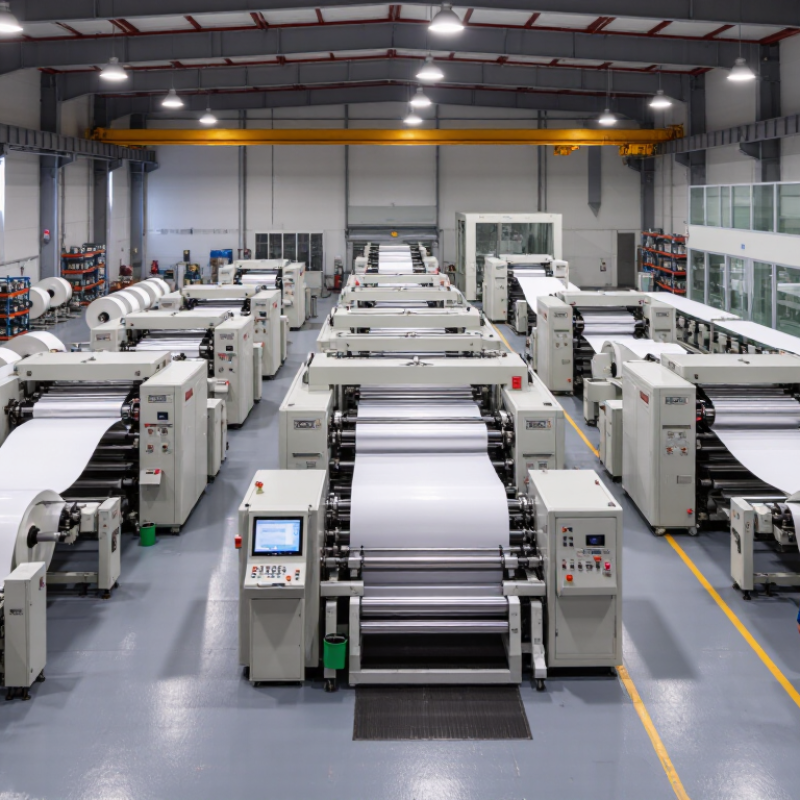
A paper coating machine applies a controlled layer of coating to a moving paper web. The coating may contain pigments, binders, water, and performance additives. It improves smoothness, brightness, print quality, and surface protection. The machine is usually part of a continuous production line.
The process begins when large paper rolls unwind under controlled tension. A pump sends the coating mixture to an applicator, such as a blade, rod, roll, or curtain system. The applicator spreads the liquid across the paper surface. A metering blade then removes excess coating and controls coat weight. Precision matters here. Small pressure changes can create streaks.
The coated web passes through air dryers or heated cylinders. These remove moisture without damaging the paper structure. Sensors monitor basis weight, moisture, tension, temperature, and coating thickness. Operators adjust viscosity and machine speed during production. In practical trials, a coating that looks stable in the tank may behave differently at high speed. No setting is perfect.
After drying, calendering can compress the surface and improve gloss. The finished paper is then inspected for pinholes, uneven coverage, curl, and visible scratches.
Experienced technicians also check the edges, because defects often begin there. A reliable machine needs accurate controls, accessible maintenance points, and stable operation over long production runs. Fancy automation cannot replace careful observation.
Top 10 Paper Coating Machine Manufacturers Worldwide: Key Technologies Used in Modern Paper Coating Machines
Modern paper coating machines depend on precise application, fast drying, and stable web control. Blade coating remains common for smooth, high-quality surfaces, while rod coating supports accurate metering at lower coat weights. Curtain coating is gaining attention because it applies a continuous liquid film without direct contact. Small changes matter.
Online sensors now measure coat weight, moisture, gloss, and surface defects across the moving web. Closed-loop controls then adjust pressure, flow, and blade position within seconds. Infrared and air-impingement dryers can shorten drying zones, although they may increase energy demand when poorly balanced. The International Energy Agency identifies industrial heat efficiency as a major pathway for reducing manufacturing energy use. That makes dryer design commercially important, not merely technical.
CEPI’s 2023 preliminary statistics reported European paper and board production of about 79.5 million tonnes, a 13.5% decline from the previous year. Under this pressure, coating machines must reduce waste during startup and grade changes. Smithers’ recent specialty-paper analysis also highlights demand for functional surfaces, including barrier and printable coatings. Operators increasingly combine machine vision with predictive maintenance to protect uptime.
A clean specification can still fail on the factory floor. Nozzle fouling, uneven viscosity, or web flutter can ruin an otherwise advanced system. In my view, manufacturers should publish verified energy, scrap, and coating-uniformity data, not only maximum speed.
Choosing among the top 10 paper coating machine manufacturers requires more than comparing catalog prices. Examine their experience with your paper grade, coating chemistry, production speed, and target finish. A supplier familiar with lightweight coated paper may not understand specialty packaging stock. Ask for references from facilities using similar raw materials. Request documented results, not polished promises.
During evaluation, inspect machine details closely. Check coating width, operating speed, drying capacity, tension control, and automatic adjustment systems. Ask how the equipment handles streaks, edge defects, foaming, and sudden moisture changes. A practical factory visit can reveal more than a sales presentation. Watch an operator change rolls. Notice cleaning time, access to inspection points, and noise around the drive system. Small details matter.
Testing should include your own coating formula and paper samples. Measure coat weight variation, gloss, smoothness, drying energy, and finished-roll waste. Require trial data with clear test conditions. Service capability also deserves careful attention. Confirm spare-parts availability, remote support hours, training plans, and response procedures. Certifications help, but they do not replace performance evidence. No evaluation is perfect. I would keep a scoring sheet, record unanswered questions, and revisit weak assumptions before signing. A low purchase price can become expensive when commissioning is slow or operators need constant manual correction. Fancy automation is not always useful.
The top 10 paper coating machine manufacturers worldwide are judged by more than production scale. Their equipment must deliver stable coating weight, smooth web handling, and reliable drying performance. Experienced buyers inspect machine design, factory controls, and after-sales support before signing contracts. A polished brochure is not enough.
Leading manufacturers usually offer blade, rod, curtain, or air-knife coating systems. Each method suits different paper grades and production targets. Operators often compare coating accuracy within a few grams per square meter.
They also examine dryer temperature control, tension stability, and cleaning access. A practical machine should reduce waste during startup and limit defects near the reel.
Independent references provide stronger evidence than marketing claims. Visit an operating mill when possible. Watch how quickly technicians replace a worn blade or adjust the coating color. Ask about spare-part delivery, software training, and service response across time zones. No ranking is flawless. Some suppliers have excellent engineering but weak local support, while others offer fast service with less flexible customization. Buyers should review trial data, energy consumption, safety systems, and long-term maintenance records. A small overlooked detail, such as difficult filter access, can create expensive downtime later.
Paper coating equipment is moving from simple speed competition toward controlled, data-driven production. Leading manufacturers now design machines that manage coating weight, moisture, tension, and drying in one connected line. Inline sensors measure the sheet continuously. Operators can detect streaks before entire rolls require rework.
Energy efficiency is shaping nearly every new specification. Modern drying sections use heat recovery, improved airflow, and precise infrared assistance. These changes can reduce fuel consumption while protecting coating uniformity. Electrified drives also support faster adjustments and smoother web handling. However, lower energy use is not automatic. Poor calibration, damaged seals, or unstable steam pressure can erase expected savings.
Automation is becoming more practical, not merely more impressive. Machine-learning tools can identify patterns in defects and recommend process changes. Remote diagnostics may shorten maintenance delays, especially for facilities with limited technical staff. Still, software cannot replace experienced operators. I have seen clean dashboards hide basic problems, such as worn doctor blades or uneven substrate moisture. That assumption is incomplete. Future equipment should combine reliable mechanics, accessible controls, and training that workers can use during a demanding shift.
Flexible production is another strong trend. Paper mills increasingly need fast product changes, water-based coatings, barrier layers, and recycled fiber grades. Equipment must handle these variations without excessive cleaning time or waste. The best engineering decisions will balance throughput, product quality, maintenance access, and measurable environmental performance. Not every advanced feature earns its cost.
| No. | Industry Trend | Verified Market or Regulatory Indicator | Implication for Paper Coating Equipment | Expected Influence | Reference |
|---|---|---|---|---|---|
| 1 | Growth of recyclable fiber-based packaging | The EU Packaging and Packaging Waste Regulation entered into force on 11 February 2025 and generally applies from 12 August 2026. | Coating lines will need to support recyclable, repulpable and fiber-compatible barrier solutions while maintaining packaging performance. | Very High | European Commission |
| 2 | Shift from plastic films to coated paper barriers | Packaging regulations increasingly emphasize recyclability, material reduction and restrictions on unnecessary single-use packaging. | Manufacturers are prioritizing multilayer coating capability, precise coat-weight control and high-barrier formulations for paper packaging. | Very High | European Commission |
| 3 | Expansion of water-based coating systems | Water-based coatings are widely used to reduce dependence on organic solvents and to support lower-VOC production environments. | Equipment design is moving toward corrosion-resistant wetted parts, improved drying capacity, foam control and accurate viscosity management. | High | U.S. EPA |
| 4 | PFAS-free grease and oil resistance | The European Chemicals Agency submitted a broad PFAS restriction proposal in 2023, covering many uses and product sectors. | Coating machinery must handle fluorine-free formulations with stable application, drying and surface-performance control. | High | European Chemicals Agency |
| 5 | Energy-efficient drying and heat recovery | Drying is one of the most energy-intensive stages in many coated-paper production processes, especially where water-based formulations are used. | Future machines will increasingly integrate efficient air management, heat recovery, insulation, automated exhaust control and low-energy curing. | Very High | International Energy Agency |
| 6 | Real-time quality monitoring | Online measurement technologies are established in paper production for monitoring basis weight, moisture, caliper and coating-related properties. | Demand is increasing for web inspection, coat-weight sensors, closed-loop actuators and automatic defect detection. | High | Confederation of European Paper Industries |
| 7 | Industry 4.0 and predictive maintenance | Industrial digitalization increasingly uses connected sensors, condition monitoring, data analytics and remote support to reduce unplanned downtime. | New coating lines are expected to include machine connectivity, asset-health dashboards, alarm analytics and maintenance forecasting. | High | National Institute of Standards and Technology |
| 8 | Flexible production and shorter changeover times | Paper converters increasingly serve multiple packaging formats, grades and coating recipes rather than a single standardized product. | Equipment value is increasingly linked to modular coating heads, recipe management, automated cleaning and rapid roll or die changes. | High | ISO Smart Manufacturing |
| 9 | Bio-based and renewable coating chemistry | Renewable raw materials and bio-based polymers are being developed as alternatives or supplements to fossil-based coating components. | Machines must accommodate broader rheology ranges, temperature sensitivity and formulation-specific drying requirements. | Medium to High | European Commission Bioeconomy |
| 10 | Water-use reduction and closed-loop operation | Water scarcity, wastewater requirements and corporate environmental targets are accelerating industrial efforts to reduce freshwater intake and discharge. | Future systems will emphasize recirculation, inline filtration, reduced wash-water demand, automated cleaning and wastewater minimization. | High | UN-Water |
Note: The table summarizes industry-wide trends and publicly documented regulatory or technical indicators; it does not rank or disclose individual manufacturers or brands.
